
piano adventures primer pdf
Piano Adventures Primer PDF: A Comprehensive Guide (Updated 12/24/2025)
Today, December 24th, 2025, the Piano Adventures Primer Level orients students to the piano, utilizing black-key pieces and off-staff note reading.
The second edition introduces key names, note values, and the grand staff, fostering pattern recognition and musical awareness through engaging exercises.
Students explore the C 5-finger scale, steps, skips, and dynamics, with the PDF offering a comprehensive learning experience for beginners.
What is Piano Adventures Primer Level?
Piano Adventures Primer Level serves as the foundational stepping stone for aspiring pianists, meticulously designed to introduce the instrument and fundamental musical concepts in an accessible and engaging manner. This initial stage, as of December 24th, 2025, focuses on building a strong base through exploration of the keyboard landscape, primarily utilizing black-key pieces.
These pieces allow students to comfortably navigate the range of the piano without the initial complexity of reading traditional notation. A core component involves “off-staff” note reading, which prioritizes learning keyboard letter names and basic rhythmic values independently of the grand staff. This approach fosters a direct connection between the visual layout of the keyboard and the corresponding musical sounds.
The Primer Level aims to cultivate musical awareness from the very beginning, encouraging students to become “music detectives” – actively listening and identifying patterns. It lays the groundwork for future success by establishing a solid understanding of musical fundamentals before introducing more complex concepts. The second edition further refines this approach, enhancing clarity and pedagogical effectiveness.
The Core Philosophy of Piano Adventures
The Piano Adventures series, including the Primer Level, is built upon a holistic approach to music education, prioritizing not just technical proficiency but also musical understanding and artistry. As of December 24th, 2025, the core philosophy centers around fostering a love for music through engaging and thoughtfully sequenced lessons.
A key tenet is the belief that students learn best when actively involved in the musical process. This is exemplified by the “music detective” approach, encouraging students to analyze and interpret musical patterns. The series emphasizes pattern recognition as a crucial skill, enabling students to quickly grasp new concepts and apply them creatively.
Furthermore, Piano Adventures champions a multi-sensory learning experience, integrating visual, auditory, and kinesthetic elements. The second edition of the Primer Level continues to refine this philosophy, offering improved clarity and a more intuitive learning path. The goal is to nurture well-rounded musicians who can express themselves confidently and joyfully through the piano.
Key Features of the Primer Level
The Piano Adventures Primer Level, as of December 24th, 2025, boasts several defining features designed for the absolute beginner. A cornerstone is the introduction to the piano through accessible black-key pieces, allowing students to immediately experience musical success and explore the keyboard’s range.

Off-staff note reading is another crucial element, teaching letter names and basic rhythms in a non-intimidating manner. The second edition builds upon this foundation, introducing the grand staff and the C 5-finger scale, fostering a solid understanding of fundamental concepts.
Emphasis is placed on recognizing steps and skips, developing aural skills, and introducing dynamics. The series encourages students to think beyond simply playing notes, becoming “music detectives” and actively engaging with the music. Supplemental materials, like companion books and CDs, further enhance the learning experience, making the Primer Level a comprehensive and engaging starting point.

Understanding the Piano Adventures Primer PDF
Piano Adventures Primer PDF documents, often scanned, provide accessible learning materials. Understanding copyright and legal sources is vital for responsible use of this resource.
Navigating the PDF requires familiarity with its structure and digital format for optimal learning.
Availability and Sources for the PDF
Finding the Piano Adventures Primer PDF requires careful consideration of legitimate sources. While readily available through online searches, many sources may infringe upon copyright. Purchasing directly from Faber Piano Adventures or authorized retailers like Amazon ensures a legal and high-quality copy.
Several websites offer digital sheet music, some with subscription models providing access to the Primer Level PDF. However, verifying the legality of these sources is crucial. Beware of websites offering free downloads, as these often contain pirated material or malware. Scanned copies, frequently labeled “Scanned with CamScanner,” circulate online, but their quality can vary significantly.
Official Faber Piano Adventures provides information on authorized distributors and digital access options. Libraries may also offer access to the PDF through their digital collections. Always prioritize legal and ethical acquisition to support the creators and ensure a reliable learning resource.
Legality and Copyright Considerations
Copyright law strictly protects the Piano Adventures Primer PDF and its contents. Unauthorized reproduction, distribution, or modification constitutes copyright infringement, carrying potential legal consequences. Purchasing a legitimate copy from Faber Piano Adventures or authorized retailers grants you a license to use the material for personal study or teaching with students.
Downloading the PDF from unofficial sources, particularly those offering free downloads, is generally illegal and unethical. These sources often distribute pirated copies, violating the rights of the copyright holder. Sharing the PDF with others who haven’t purchased a license is also a violation of copyright law.
Respecting copyright ensures the continued creation of high-quality educational materials. Supporting Faber Piano Adventures through legal purchases allows them to invest in future editions and resources. Always verify the legitimacy of any online source before downloading or using the Piano Adventures Primer PDF.
Navigating the PDF Document
The Piano Adventures Primer PDF typically features a user-friendly interface, though functionality can vary depending on the PDF viewer used. Most versions include a table of contents with clickable links, allowing quick access to specific lessons or sections. Utilize the page thumbnails panel for visual navigation, enabling you to jump directly to desired pages.
The search function is invaluable for locating specific terms, musical concepts, or exercises within the document. Zooming capabilities enhance readability, particularly on smaller screens. Many PDFs include interactive elements, such as embedded audio examples or hyperlinks to supplemental resources.
Be aware that some scanned PDFs, labeled as created with CamScanner, may have limited searchability or interactive features. Familiarize yourself with your PDF viewer’s tools to maximize your navigation experience and efficiently access the wealth of information contained within the Piano Adventures Primer PDF.
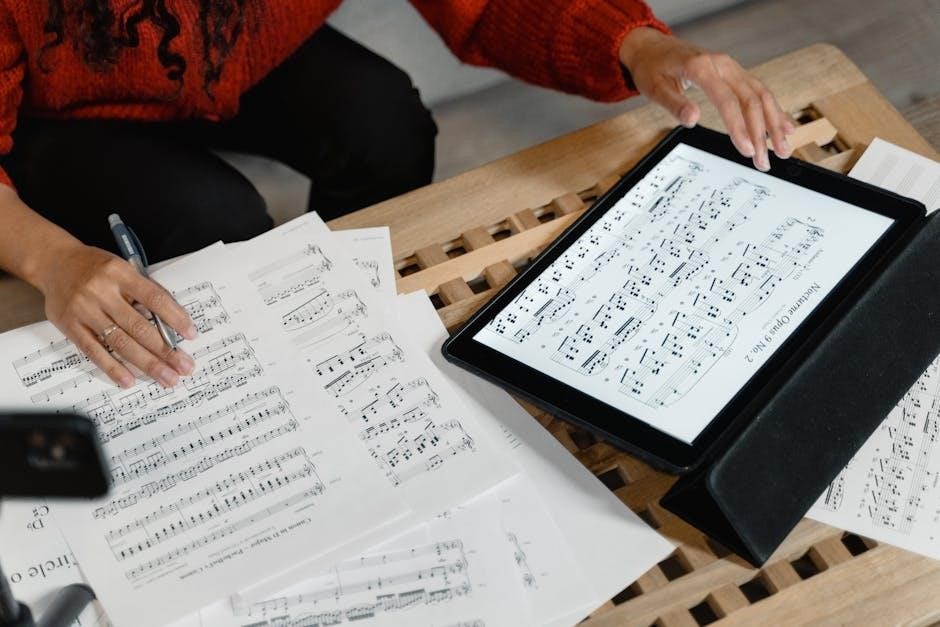
Content Breakdown: What Students Learn
Piano Adventures Primer introduces the keyboard via black-key pieces, teaches off-staff note reading, and establishes basic rhythms, building a foundation in music.
Students master the C 5-finger scale, recognize steps and skips, and learn note names independently.
Piano Adventures Primer Level strategically begins by familiarizing students with the piano keyboard through engaging black-key pieces. This approach cleverly avoids initial complexities of reading staff notation, allowing beginners to immediately experience musical exploration and success.
These initial pieces focus entirely on the black keys, enabling students to quickly grasp the concept of musical range and develop a comfortable physical connection with the instrument. The method encourages students to explore the keyboard’s breadth, building confidence and spatial awareness.
By starting with black keys, the Primer Level simplifies the learning process, fostering a positive first impression and laying a solid foundation for future musical endeavors. This method prioritizes tactile learning and immediate musical gratification, making the initial stages of piano study enjoyable and accessible for young learners. It’s a carefully designed introduction to the world of piano playing.
Off-Staff Note Reading: Letter Names & Basic Rhythms
Following the introduction to the keyboard, Piano Adventures Primer Level seamlessly transitions to off-staff note reading, a crucial step in building foundational musical literacy. This innovative approach teaches students the names of the keys – C, D, E, F, G – directly in relation to their position on the keyboard, bypassing the initial hurdle of the grand staff.
Simultaneously, the Primer Level introduces basic rhythms, allowing students to connect note names with rhythmic values. This integrated learning experience fosters a holistic understanding of musical notation, rather than treating pitch and rhythm as separate concepts.
The method emphasizes recognizing letter names independently of finger numbers, promoting a deeper understanding of musical structure. This off-staff approach builds confidence and prepares students for the eventual introduction of the grand staff, ensuring a smooth and successful transition into traditional music reading.
The C 5-Finger Scale & Position
A cornerstone of the Piano Adventures Primer Level is the introduction of the C 5-finger scale and position. This foundational element provides students with a comfortable and manageable starting point for developing technique and musicality. The C position, utilizing fingers 1-5 on C-D-E-F-G, allows for easy access to a cluster of notes, fostering a sense of security and control.
Students learn to play simple melodies and exercises within this limited range, building finger dexterity and coordination. The Primer Level emphasizes playing with a relaxed hand position and even touch, establishing good habits from the outset.
This focused approach on the C 5-finger position not only builds technical skills but also reinforces note recognition and pattern awareness, preparing students for more complex musical concepts and expanding their keyboard range in subsequent levels.

Teaching Strategies & Tips
Primer Level success hinges on encouraging “music detectives” – building awareness beyond notes. Foster pattern recognition and explore dynamics, even introducing pedal usage early on.
Engage students with playful activities!
Encouraging Musical Awareness: “Music Detectives”
Transforming students into “Music Detectives” is a cornerstone of the Piano Adventures Primer Level approach. This strategy moves beyond rote memorization, fostering a deeper understanding of musical concepts. Encourage students to actively listen and analyze the music, rather than simply playing the notes.
How does it work? Present musical excerpts as “cases” to solve. For example, ask students to circle repeating patterns in measures 1 and 2, acting as investigators. Provide “clues” – questions about dynamics, rhythm, or melodic direction – to guide their exploration. This cultivates critical listening skills and encourages them to think beyond the individual notes on the page.
David, the Allegro Detective Agency, is a fun role-playing prompt. This imaginative approach makes learning more engaging and memorable. By actively seeking out musical elements, students develop a stronger connection to the music and a more intuitive grasp of its structure. This detective work builds a foundation for future musical understanding.
Developing Pattern Recognition
Pattern recognition is fundamental to musical literacy, and the Piano Adventures Primer Level strategically incorporates exercises to cultivate this skill. The curriculum emphasizes identifying repeating sequences in both melodic and rhythmic structures, building a strong foundation for reading and performing.
Early lessons focus on recognizing patterns within the C 5-finger scale, allowing students to internalize the relationships between notes. This is further reinforced through off-staff note reading, where students learn to associate letter names with specific keyboard positions. Recognizing these patterns accelerates note-learning and improves fluency.
The “Music Detective” approach complements pattern recognition by encouraging students to actively search for repetitions in musical excerpts. Circling identical patterns in different measures solidifies their understanding. This active engagement transforms learning from passive reception to active discovery, fostering a deeper and more lasting comprehension of musical structure.
The Importance of Dynamics and Pedal Usage
The Piano Adventures Primer Level introduces dynamics and pedal usage early on, recognizing their crucial role in expressive musical performance. While seemingly advanced for beginners, the curriculum integrates these elements in a simplified and accessible manner, fostering musicality from the start.
Students learn to interpret dynamic markings – such as piano and forte – and apply them to their playing, adding nuance and character to simple melodies. The Primer Level encourages a “coloristic” use of the pedal, meaning it’s introduced not for complex legato, but to enhance the overall sound and create subtle effects.
This early exposure cultivates an awareness of tonal variation and encourages students to think beyond simply playing the correct notes. It lays the groundwork for more sophisticated dynamic control and pedaling techniques in subsequent levels, building a well-rounded musical foundation.

Specific Exercises & Activities
Primer Level exercises focus on exploring steps and skips, identifying note values, and initial concepts of reading on the grand staff.
These activities build foundational skills through engaging practice, preparing students for more complex musical concepts and notation.
Exploring Steps and Skips
Piano Adventures Primer Level introduces the concepts of steps and skips as fundamental building blocks for understanding musical intervals. These exercises are crucial for developing a student’s ear and visual recognition of melodic movement. The Primer Lesson Book specifically incorporates activities designed to help students differentiate between the short distance of a step – moving to an adjacent key on the piano – and the larger distance of a skip.
Initially, students explore these intervals within the context of the C 5-finger scale, reinforcing their understanding of note names and keyboard geography. Activities might involve identifying steps and skips visually in the music, or physically playing them on the piano. The goal is to move beyond simply recognizing notes and begin to understand the relationships between them.
Through consistent practice, students build a strong foundation for reading music and improvising simple melodies, recognizing patterns and predicting where the music will go next. This early exposure to intervallic relationships is vital for future musical development.
Identifying Note Values
Piano Adventures Primer Level systematically introduces fundamental note values, laying the groundwork for rhythmic understanding. The curriculum begins with visually distinct note representations – whole notes, half notes, quarter notes – and their corresponding rests. Students learn to associate these symbols with durations of sound and silence, initially through clapping and rhythmic speech before applying them to the piano.
The Primer Lesson Book utilizes a clear and progressive approach, often employing visual cues and patterns to reinforce the concept of note value relationships. For example, students might learn that a half note receives two beats, and two quarter notes equal one half note.
Exercises focus on recognizing and performing simple rhythmic patterns, building a strong internal sense of pulse and timing. This early emphasis on rhythmic accuracy is crucial for developing a solid musical foundation and preventing bad habits later on.
Reading on the Grand Staff: Initial Concepts
Piano Adventures Primer Level gently introduces students to the grand staff, beginning with a focus on landmark notes. Rather than overwhelming learners with all notes simultaneously, the curriculum strategically introduces notes in relation to familiar black key groupings. Students initially learn to identify notes off the staff, associating them with their corresponding key names on the piano.
The Primer Lesson Book then gradually introduces notes on the staff, starting with middle C and expanding outwards. Visual aids, such as mnemonics and colorful illustrations, are frequently used to help students remember the names of the lines and spaces.
Early exercises emphasize recognizing and naming notes within a limited range, building confidence and establishing a strong foundation for more complex reading skills; The goal is to foster a connection between the visual representation of notes on the staff and their physical location on the keyboard.

Comparing Editions: 1st vs. 2nd Edition
The second edition of Piano Adventures Primer presents improvements, introducing key names, note values, and the grand staff with enhanced clarity.
It fosters pattern recognition and musical awareness, making it a valuable upgrade for students.
Changes and Improvements in the 2nd Edition
The 2nd Edition Primer Lesson Book represents a significant evolution in pedagogical approach, building upon the strengths of the original while addressing areas for refinement. A key improvement lies in the more systematic introduction of musical concepts, particularly regarding note values and the grand staff. Students now encounter these elements with greater clarity and a more logical progression.
Furthermore, the 2nd Edition emphasizes the development of pattern recognition skills from the very beginning. Exercises are designed to encourage students to “think beyond the notes,” acting as “music detectives” to identify recurring motifs and structures. This fosters a deeper understanding of musical form and enhances analytical abilities.
The inclusion of coloristic guidance for pedal usage is another notable enhancement, introducing this important expressive element in a developmentally appropriate manner. Overall, the 2nd Edition aims to provide a more engaging, comprehensive, and effective learning experience for beginning piano students, solidifying foundational skills and cultivating a lifelong love of music.
Which Edition is Best for Your Student?
Determining the optimal edition of Piano Adventures Primer hinges on the student’s learning style and existing musical foundation. While both the 1st and 2nd editions are valuable resources, the 2nd Edition generally proves more beneficial for most beginners due to its refined pedagogical approach.
If your student thrives with a highly structured and systematic learning environment, the 2nd Edition’s clearer presentation of concepts and emphasis on pattern recognition will be particularly advantageous. The enhanced exercises and coloristic pedal guidance further contribute to a more comprehensive learning experience.
However, if your student benefits from a more exploratory and intuitive approach, the 1st Edition may suffice. Ultimately, consider a trial period with both editions, observing which resonates more effectively with the student’s individual needs and learning preferences. A happy student is a successful student!

Supplemental Resources
Companion books and CDs enhance the Piano Adventures Primer experience, while numerous online resources and websites offer additional support.
Google Maps surprisingly inspires musical exploration through route planning, connecting geography to rhythm and melodic concepts for creative learning.
Companion Books & CDs
Faber Piano Adventures offers a wealth of supplemental materials designed to reinforce and expand upon the concepts introduced in the Primer Level.
The Primer Level Performance Book provides carefully selected pieces that allow students to apply their newly acquired skills in a musical context, building confidence and artistry.
CDs accompanying the lesson and performance books feature professional recordings of all pieces, enabling students to internalize correct rhythms, phrasing, and dynamics.
These audio resources are invaluable for developing aural skills and fostering a deeper understanding of musical expression;
Furthermore, the Teacher’s Edition provides detailed guidance and suggestions for effective teaching, including lesson plans, activity ideas, and assessment tools.
These resources ensure a well-rounded and engaging learning experience, supporting both students and educators in their musical journey.
Exploring these materials unlocks a richer, more comprehensive understanding of the Piano Adventures Primer curriculum.
Online Resources & Websites
Numerous online resources complement the Piano Adventures Primer Level, enhancing the learning experience beyond the physical books.
The official Google Maps Help Center, while not directly music-focused, demonstrates the power of digital tools for spatial reasoning – a skill transferable to understanding musical intervals and keyboard layout.
Websites dedicated to music education often feature supplementary exercises, printable worksheets, and interactive games aligned with the Piano Adventures curriculum.
YouTube channels offer video tutorials demonstrating proper technique, repertoire performances, and explanations of musical concepts.
Online forums and communities provide a platform for students, teachers, and parents to connect, share ideas, and seek support.
These digital tools offer flexibility and accessibility, allowing learners to practice and explore music at their own pace.
Utilizing these resources can significantly enrich the learning process and foster a lifelong love of music.
Using Google Maps for Musical Inspiration (Route Planning & Exploration)
Surprisingly, Google Maps can inspire musical creativity, even when learning the Piano Adventures Primer Level! The act of route planning mirrors musical phrasing – identifying starting points, navigating through sections, and reaching a destination.
Exploring different routes on Google Maps parallels experimenting with musical variations. The “best route” (highlighted in blue) can represent a clear, direct musical line, while alternative routes suggest harmonic or melodic embellishments.
Street View offers visual landscapes, sparking imaginative storytelling through music. Students can “travel” virtually and compose pieces inspired by the places they “visit.”
Considering modes of transport – driving, walking, cycling – can translate into tempo and dynamic variations. A fast car ride might inspire a lively allegro, while a leisurely walk suggests a gentle andante.
This unconventional approach encourages students to connect music with the world around them, fostering a deeper understanding and appreciation for both.